

Executive Summary
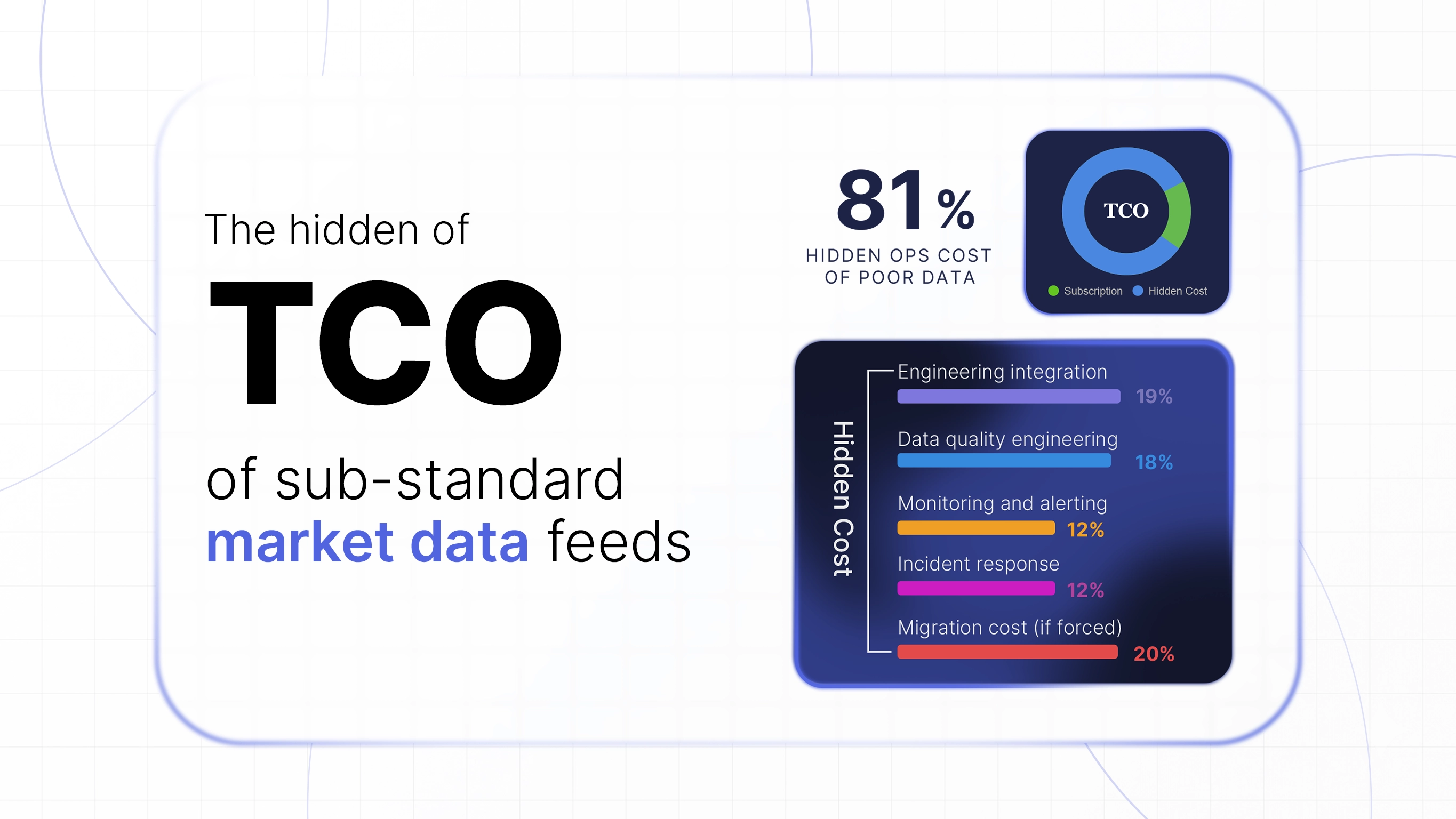
- The Core Problem: The initial market data subscription price represents only 19% of a firm's true 3-year market data total cost of ownership (TCO). The remaining 81% is absorbed by internal engineering.
- The 6 Hidden Taxes: Firms using retail-grade data pay heavily in Integration Tax (broken SDKs), DevOps Tax (custom reconnect handling), Data Quality Tax (upstream noise filtering), Compliance Tax (mismatched live/historical paths), Migration Tax (inability to scale), and Trust Tax (downstream churn from bad prints).
- The Solution: Transitioning to a high-quality institutional market data feed via a single, consolidated financial market data API can drop fully-loaded engineering costs by 30% to 40%.
The headline price is the smallest line in the TCO model.
The cost a market data vendor doesn't quote you — across FX, equities, crypto, indices, or CFDs — is the cost of integrating, monitoring, and working around their feed for the next three years. Procurement scores the subscription line. Engineering pays the rest.
Below is the model that surfaces the true market data total cost of ownership (TCO), and a candid look at how vendors with sticker-price advantages quietly recover their margin from the buyer's engineering org.
Managing the Three-Year Market Data TCO Model
Most market data contracts run for three years. Most TCO conversations stop at year one. The gap is where the real money lives.
A worked model looks like this — numbers are illustrative; substitute your own engineering rates.
| Cost Component | Year 1 | Year 2 | Year 3 | 3-Year Total |
|---|---|---|---|---|
| Subscription | $30K | $30K | $33K | $93K |
| Engineering integration | $75K | $10K | $10K | $95K |
| Monitoring and alerting | $20K | $20K | $20K | $60K |
| Data quality engineering | $40K | $25K | $25K | $90K |
| Incident response | $15K | $20K | $25K | $60K |
| Migration cost (if forced) | — | — | $100K | $100K |
| Total | $180K | $105K | $213K | $498K |
The subscription is 19% of the three-year cost. The other 81% is what the vendor told you was your problem to solve.
The fully-loaded comparison often inverts the sticker order. A vendor whose pricing reflects the engineering done at source — transparent commercials, no overage traps, no separate contract for the historical archive — frequently lands 30–40% cheaper on fully-loaded TCO than a feed with a lower headline that recovers its margin from the buyer's engineering org. The right vendor isn't the most expensive in the market. It's the one whose pricing matches the work they actually do, so you don't pay to redo it.
That's the conversation a CFO needs to see before signing.
The Six Hidden Costs of Low-Cost Feeds
1. The Integration Tax
A retail-grade feed ships with thin docs, undocumented error responses, and an SDK two release cycles behind. The team burns three sprints on adapter code, retry logic, and ambiguous error tracing — work that should have been a one-week task.
An institutional market data feed ships differently: versioned docs, working samples in Python, Go, Node, Java, and C#, a Postman collection, a web playground, an MCP (Model Context Protocol) integration for AI-assisted development, and clear error semantics. A team lands in production in a week, not a quarter.
The integration tax is front-loaded, which makes it easy to dismiss as a one-time spike. It isn't. It sets the cultural baseline for everything that follows — every later feature inherits the friction of the original integration. In a multi-asset stack, you pay it per vendor.
2. The DevOps Tax
The DevOps tax is what your platform team pays every quarter, forever, to compensate for engineering the vendor didn't do on their financial market data API:
- Custom reconnect logic the vendor's WebSocket library should have provided.
- Monitoring dashboards built to detect outages the vendor's status page misses.
- Pager rotations for tick-completeness anomalies the vendor doesn't alert on.
- Manual gap-fill scripts after every disconnect because there's no recovery API.
- Synthetic test clients confirming the feed is actually live where the marketing claims.
None of this work creates customer value. An institutional feed retires it by design — automatic reconnect semantics, a historical tick API for on-demand backfill with source timestamps preserved, and an SLO-instrumented status page the platform team can defer to instead of duplicating.
3. The Data Quality Tax
This is the line item buried inside data engineering and labeled "internal tooling."
Sub-standard feeds ship with stale prices, crossed bids/asks, off-venue prints, outlier ticks during low liquidity, and inconsistent symbology between live and historical paths. Your team writes outlier detection, cross-venue consistency checks, stale-tick suppression, and synthetic cross-rate validation — then maintains it for the life of the contract.
The Enterprise Solution: An institutional pipeline secures real-time financial data quality upstream. Tier-1 bank and venue contributions are filtered before the tick reaches the client. Cross-rate consistency is enforced on the vendor side: when $EUR/USD \times USD/JPY$ drifts from native $EUR/JPY$, the discrepancy is flagged in the feed, not left for the client to discover during a backtest.
Each asset class adds its own quality quirks — corporate action drift in equities, off-venue noise in crypto, publishing latency variance in indices. A firm consuming five sub-standard feeds is running five parallel quality engineering efforts.
4. The Compliance Tax
A regulator asks for a reconstruction of the order book at 14:30:00.124 UTC on a Tuesday. The team pulls the historical archive — and discovers the historical record doesn't match what streamed live that day. Source timestamps were rewritten on ingest. Ticks during a burst event are missing. The cross-venue snapshot can't be aligned to the millisecond.
Now the compliance team is running manual reconciliation, writing remediation memos, and explaining gaps to the regulator. The cost is enormous and almost entirely hidden — it shows up as compliance headcount, not market data cost.
The architecture that eliminates this tax aligns the historical archive byte-for-byte with what streamed live, with source timestamps preserved end-to-end. A tick stamped at 14:30:00.124 UTC in production is recorded at 14:30:00.124 UTC in the archive, from the same contributor, at the same precision. That's a forensic audit trail by construction, not a feature toggle.
5. The Migration Tax
This is the cost everyone thinks won't apply to them — until it does, in year three, at the worst possible time. The feed fails to scale, a new asset class isn't supported, a merger consolidates two stacks, a new regulatory regime needs audit features the vendor doesn't offer. Suddenly the team is running parallel feeds, burning quarters on cutover, and managing the risk of the transition itself.
The architecture that minimizes this risk has two properties: a single integration covering every asset class the buyer might add in future, and delivery formats — WebSocket, REST, FIX, Snowflake direct shares, Excel and Sheets add-ons — that fit whatever stack the buyer's teams already run. The cost of moving away never disappears entirely, but it collapses from "a strategic migration" to "an integration refactor."
6. The Trust Tax
The first five costs land on engineering. This one lands on revenue.
- Trading Platforms: A stale print shows up as a customer complaint, a refund request, and — at scale — as user churn.
- Remittance Products: A cloudy mid-market rate compresses the margin the customer was promised and erodes brand trust.
- Hedge Funds: A bad tick that hits an execution model loses real P&L and credibility on the desk.
Most of these costs never reach the market data line of the budget. They get filed under customer service, marketing, retention, or — worst — written off as bad luck. Every one of them traces back to the quality of the feed.
How "Cheap" Vendors Make Money
A vendor selling below cost on the headline subscription still has to earn margin somewhere. Four patterns recur:
- Per-symbol pricing creep: "Up to 50 symbols included." The team adds a 51st. The overage unit price is three times the bulk rate.
- Bandwidth and message overage: Light usage during the PoC, three times higher in production. The contract structure routes everything above the PoC pattern into a metered tier with vendor-favorable economics.
- Historical data as a separate product: Live feed in the contract. Matching historical tick archive — needed for backtesting, audit, and reconciliation — on a separate line, sometimes a separate vendor. Discovered in month four.
- Premium support for basic operations: Production-grade response times require the Enterprise tier. Standard tier means a 48-hour helpdesk SLA. When the feed fails at 03:00 UTC during the Tokyo open, the buyer learns "support" and "available support" are different products.
By the time the buyer notices, the migration tax makes leaving expensive enough to absorb the overages.
The CFO Conversation: Reframing the Buy
A defensible TCO model gives finance two reframes that change how the contract is evaluated.
Reframe the denominator: A market data contract isn't a cost — it's an input to revenue-generating systems. The right question is not "what is the annual fee?" but "what is the P&L cost of one bad day on the feed?" For most institutional buyers, a single missed FOMC event or a botched audit archive exceeds the annual contract.
Reframe the comparison: Two vendors with different sticker prices are not comparable until the hidden costs are added to both. Once they are, the headline order frequently flips — and the answer isn't usually the most expensive vendor in the market.
The Multi-Asset Multiplier
Every cost above multiplies with every additional vendor in the stack.
A firm consuming FX from one vendor, equities from another, crypto from a third, and indices from a fourth pays each tax four times. The aggregate hidden cost of a fragmented multi-asset feed is frequently larger than the entire institutional data budget at a comparable single-vendor firm.
This is where multi-asset data consolidation lands in financial terms — not as a feature pitch, but as the structural way to collapse the hidden TCO components into a single integration, a single monitoring layer, a single quality framework, a single audit path. The savings show up on the engineering headcount line, the incident response line, and the compliance line — none of which appear in the market data RFP.
A CFO who funds a market data consolidation isn't buying a feature. They're retiring four years of duplicated engineering cost.
Have a market data contract coming up for renewal? Talk to a TraderMade data engineer about how to map out a defensible market data total cost of ownership (TCO) model for your specific infrastructure.
TraderMade provides institutional market data feeds across FX, equities, crypto, indices, and CFDs. Built on a single financial market data API with source-timestamped tick archives and full live/history parity, our infrastructure is designed to eliminate the engineering taxes of legacy, fragmented providers.