

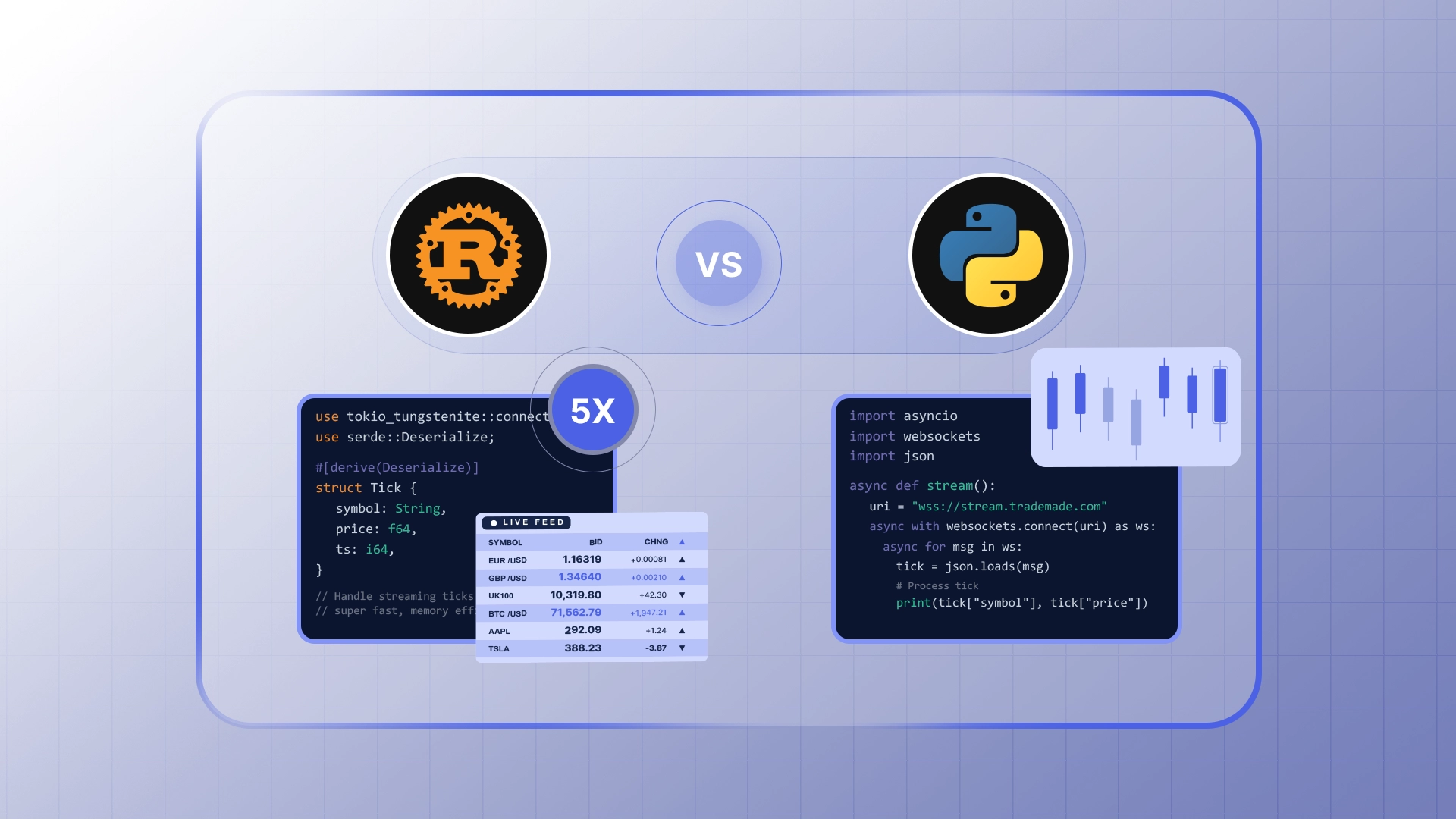
When people compare Rust vs Python for market data streaming, the question is usually framed too simply: is Rust faster than Python for WebSockets?
The better question is: is Rust worth the extra development effort for your specific workload?
The answer depends entirely on what happens to each tick after it reaches your machine.
Wire Speed vs. Processing Speed
A Python script and a Rust binary connected to the same feed are both waiting on the same network. The WebSocket packets do not arrive earlier just because the client is written in Rust. The wire speed is identical.
The difference starts the moment the JSON message lands.
Once a tick arrives, your client has to parse it, read the symbol, convert the bid and ask into numbers, update an in-memory book, calculate a mid-price, and hand it to the rest of your application. This hot path serialization is where Rust becomes significantly cheaper than Python.
When to Choose Python vs. Rust
| Choose Python when... | Choose Rust when... |
|---|---|
| You are prototyping or exploring data | You are handling high tick rates across many symbols |
| Consuming a small number of symbols | Low and predictable latency is a hard requirement |
| Building dashboards, notebooks, or internal tools | The feed handler is core system infrastructure |
| Readability and quick iteration matter most | You want to maximize efficiency on a single core |
The Toy Box Analogy: Dynamic vs. Static Data
Imagine you are sorting toys.
Python gets a big, messy toy box. Every time it picks something up, it asks at runtime: "Is this a car? Is this a dinosaur? Where should I put it?" This works, but it forces the CPU to ask the same questions for every single toy.
Rust has labeled bins mapped out before the toys even arrive: Cars → here, Dinosaurs → here. When Rust sees a toy car, it goes straight to the car bin. No questions asked.
When streaming real-time Forex or market data, the exact same pattern applies. A tick from a market data feed typically looks like this:
{
  "s": "EURUSD",
  "b": "1.16270",
  "a": "1.16272",
  "t": "QUOTE"
}
Python reads this dynamically: "Let me check what keys are inside this dictionary." Rust reads this statically: "This matches the pre-defined Quote memory layout. Put it directly into the Quote slots."
Why Python Gets Expensive Per Tick
In Python, each incoming WebSocket message is parsed into a dynamic dictionary. You do not need to define the message shape upfront, giving you maximum flexibility to call fields as you go:
m = json.loads(raw)

symbol = m["s"]
bid    = float(m["b"])
ask    = float(m["a"])

book[symbol] = (bid, ask, (bid + ask) / 2.0)
This code is short, readable, and highly adaptable. However, the CPU pays for this flexibility on every single tick.
Every message creates a brand-new dictionary object in memory. Every field access requires scanning for its hash key. Additionally, because the bid and ask arrive as strings, they must undergo expensive float conversion on the hot path. Across millions of daily ticks, these small overhead costs compound rapidly.
Why Rust Is Cheaper After the Packet Lands
Rust shifts the structural work from runtime to compile time. Instead of using a flexible shelf and looking up labels on the fly, you define a fixed shape for the exact data fields you expect using a struct.
use serde::Deserialize;

#[derive(Deserialize)]
struct Tick {
    s: String,

    // Parses string fields ("1.16270") directly into numeric f64 memory slots
    #[serde(deserialize_with = "de_f64")]
    b: f64,

    #[serde(deserialize_with = "de_f64")]
    a: f64,
}
Because f64 is a 64-bit floating-point number, the bid and ask values are handled purely as numeric metrics—no dynamic string parsing is needed inside your loop.
Once serde_json passes the payload into your Tick struct, Rust already knows exactly where tick.b and tick.a live in memory.
// Parse raw JSON directly into the statically typed struct
let tick: Tick = serde_json::from_str(raw)?;

// Update the book using direct field access with zero dictionary lookups
book.insert(
    tick.s,
    (tick.b, tick.a, (tick.b + tick.a) / 2.0),
);
Head-to-Head Architecture Comparison
| Pipeline Step | Python | Rust |
|---|---|---|
| Message Arrival | Parses into a dynamic runtime dictionary | Parses into a fixed, typed struct |
| Read Symbol | m["s"] — Dynamic key lookup overhead |
tick.s — Resolved memory address |
| Read Bid/Ask | float(m["b"]) — String conversion at runtime |
tick.b — Pre-parsed binary f64 |
| Update Book | Hash map insertion with dynamic values | HashMap insertion with fixed primitives |
| Per-Tick Overhead | Dict allocations + string hashing + type checking | Direct field access + single-pass parsing |
Benchmark: Rust vs Python
Live Stream Processing Latency
To back the performance claim, we logged the local processing cost per tick across a 10-minute live run. Network time was identical. The metric tracked is proc_ns the time to parse data, read fields, calculate the mid-price, and update an in-memory map.
| Metric | Rust | Python |
|---|---|---|
| p50 (Median Latency) | 2,500 ns | 20,300 ns |
| p99 (Tail Latency) | 14,200 ns | 84,500 ns |
While neither client dropped packets in this specific environment, the real takeaway is CPU headroom. Rust processes data fast enough to leave massive computational room for complex alpha generation or additional trading pairs on a single thread.
Parsing Performance Across Serialization Formats (JSON vs. CSV vs. SSV)
Data formats impact your throughput just as much as the language itself. We ran micro-benchmarks isolating the parsing speed of a single market data tick across three common wire formats: JSON, CSV, and Space-Separated Values (SSV).
| Format | Rust | Python | Performance Gap (Python ÷ Rust) |
|---|---|---|---|
| JSON | 288 ns | 2,673 ns | ~9.3× Faster |
| CSV | 189 ns | 864 ns | ~4.6× Faster |
| SSV | 203 ns | 804 ns | ~4.0× Faster |
Switching a Python architecture from JSON to flat CSV strings cuts its overhead by roughly 3× (dropping from 2,673 ns to 804 ns). However, even when Python runs at its absolute limit with flat delimited strings, Rust’s JSON parsing engine still beats it out of the box while retaining full data structure readability.
The Verdict: When Is Rust Worth It?
Rust won't change your ping, but it vastly optimizes your local computing capacity.
For quick data science experiments, Jupyter Notebook exploration, and low-volume streams, Python remains the most practical choice. But when your tick volume scales into thousands of messages per second and tail latency matters, Rust's static memory model gives your trading infrastructure the efficiency it needs.
Moving Beyond the Theory
If you are fighting CPU bottlenecks or want to build a high-frequency trading feed handler that scales linearly, utilizing a native compiled language is your next logical step. To help you skip the boilerplate, we have open-sourced a production-ready client architecture that manages WebSocket handshakes, connection heartbeats, and high-speed safe deserialization.
- Step-by-Step Architecture: Walk through the full implementation in our Market Data Rust WebSocket Client Tutorial.
- The Codebase: Clone the repository and run these benchmarks locally using the TraderMade Rust WebSocket Client GitHub.