

The Federal Reserve delivered its first rate cut since 2008 and this has brought the Forex market to life. It is high time we look at how the FOMC members stack up on the hawks and doves scale as we head into a period of uncertainty, caused by trade wars, central bank policies and Brexit.
Before we delve deeper into what members have said and how voting rights might change Fed policy going forward, let's look at how they look currently.
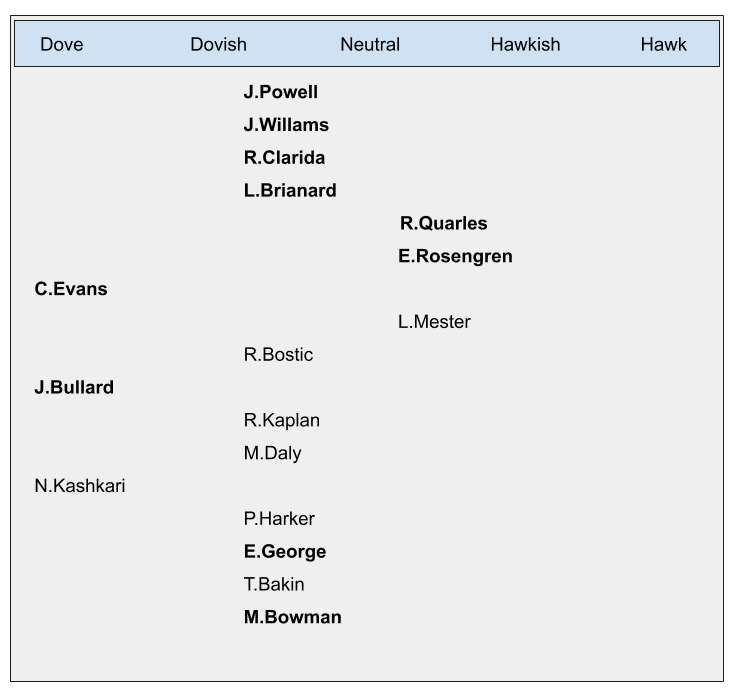
As is obvious from the graphic above, out of the eighteen members in the FOMC, twelve members are neutral or centrist, with E. Rosengren, R. Quarles and L. Mester leaning to the hawkish side and Bullard, C. Evans and Kashkari tilting to the dovish side.
Out of the eighteen members in the Federal Reserve System, only ten members have voting rights. Let's see what the voting members have said lately and what this means for monetary policy. The Fed Chair Jerome Powell said at the last policy meeting that the rate cut was not the start of a full-scale rate-cut cycle, nor was it a one-off rate cut. John Williams said that "When you only have so much stimulus at your disposal, it pays to act quickly to lower rates at the first sign of economic distress". Fed Vice Chair Richard Clarida has made similar comments, but we consider all three of these members neutral in terms of monetary policy. Esther George said lately that "we are in a good range in terms of thinking about monetary policy action" and has voted against the policy action. She is also considered a centrist.
Eric Rosengren recently said that he does not want to ease if the economy is doing perfectly fine (he also voted against the policy action), while Charles Evans said that "There is an argument that if I think it takes 50 basis points before the end of the year to get inflation up, then something right away would make that happen sooner". We would consider Rosengren slightly hawkish, while Evans is clearly dovish. James Bullard is an out-and-out dove, as he made it quite obvious before the meeting that a rate cut was coming.
If we consider voting rights and what members have said, then of the ten voting members (shown in bold in the graphic) two members each lean to the dovish and hawkish side, with six sticking to the centre. This suggests that any extreme measures concerning Fed policy are highly unlikely.
Looking a bit further out, voting rights will change in 2020, with Kashkari, Kaplan, Harker and Mester gaining voting rights while Bullard, Evans, Rosengren and George lose them. It looks unlikely that the mix of doves, hawks and centrists will change meaningfully. That said, the opinions of FOMC members can change, and this could have a significant impact on U.S. monetary policy.